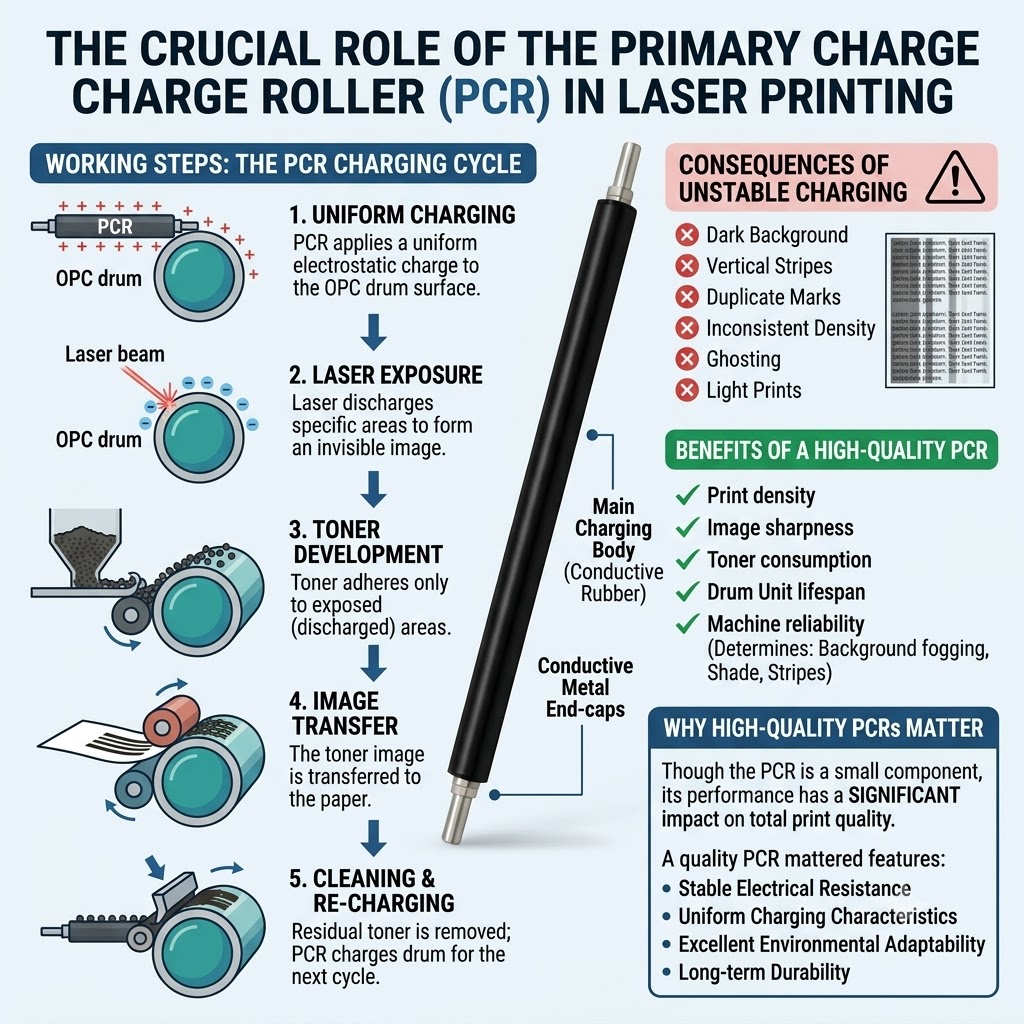
The Primary Charge Roller (PCR) is a core component of copiers and laser printers, responsible for uniformly charging the OPC Drum. Its main function is to apply a uniform charge to the surface of the OPC Drum before laser exposure. The charging quality directly affects image density, background cleanliness, color consistency, and overall print quality.
I. PCR origin (1960s–1970s)
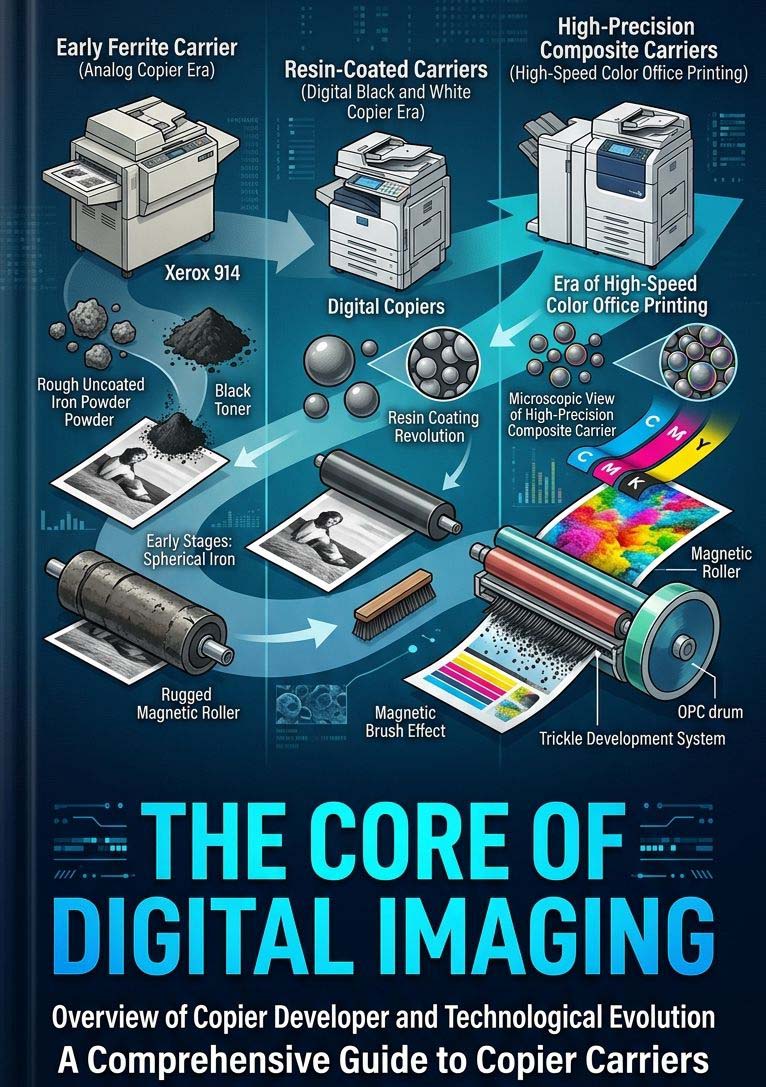
In 1959, Xerox launched its first commercial electrostatic copier, the Xerox 914, which used Corona Wire charging. However, it charging had several drawbacks: it generated large amounts of ozone, caused dust accumulation, had high power consumption, and was very environmentally unfriendly.
In the late 1970s–early 1980s, to solve the ozone and maintenance problems, the contact Primary Charge Roller (PCR) began development: using an elastic roller to directly contact the OPC Drum surface, applying −500~−800V, resulting in more uniform charging and significantly reduced ozone.
II. Evolution of PCR Technology:
First Generation: Pure Metal Rollers (Early to Mid-1980s)
Structure: A solid metal (steel / aluminum / nickel-plated) coated with a conductive rubber layer, directly contacting the OPC drum surface.
Characteristics: Good electrical conductivity, simple structure, and low cost. However, it suffers from high hardness (prone to scratching the OPC Drum), poor elasticity, uneven contact, and relatively high ozone emissions, with a sub-optimal service life.
Second Generation: Conductive Rubber Rollers (Late 1980s to 1990s)
Structure: A metal core covered by a single-layer conductive rubber (carbon black-filled EPDM / NBR).
Breakthroughs: Good elasticity (Shore hardness of 60–80A), conformable surface contact, uniform charging, and significantly reduced ozone emissions. However, it is plagued by issues such as carbon black migration, susceptibility to aging, resistance drift, cracking, and a short lifespan (50,000–150,000 pages).
This generation laid the foundation for modern conductive rubber roller manufacturing.
Third Generation: Multi-layer Composite Conductive Rubber Roller (2000s–early 2010s, still mainstream), currently the mainstream technology used by most OEMs and high-end compatible products.
1. Elastic layer (EPDM/polyurethane, providing elasticity);
2. Conductive layer (carbon nanotubes/conductive polymers, stabilizing resistance);
3. Surface coating (Fluororesin/polyurethane, anti-stick, wear-resistant, moisture-proof).
Core improvements: Stable resistance (10⁷–10⁹Ω), temperature and humidity resistance, anti-toner adhesion, extended lifespan to 200,000–500,000 impressions, low OPC Drum wear, improved color accuracy.
Future Development Trends of PCR Technology
New features: Embedded resistance monitoring, pressure sensing, temperature sensing, predictive maintenance algorithms, nano-reinforcement (graphene/carbon nanotubes), lifespan up to 1 million impressions, simplified structure, reduced cost.
Real-time monitoring and adjustment: Data monitoring and adjustment, real-time health monitoring, automatic charging optimization, reduced downtime, improved service efficiency, and longer lifespan;
Adaptive control: Automatic pressure/temperature adjustment to adapt to environmental fluctuations; self-healing coating.
More environmentally friendly materials: Bio-based elastomers (soybean-based/starch-based), recyclable polymers, free of heavy metals, and low in VOCs.
III. The working steps of the Primary Charge Roller (PCR) in printing are as follows:
Step 1: Uniform charging. The Primary Charge Roller (PCR) applies a uniform electrostatic charge to the surface of the Organic Photoconductor (OPC) drum.
Step 2: Laser exposure. The laser selectively discharges onto specific areas of the drum, forming an invisible electrostatic image.
Step 3: Toner development. Toner particles adhere only to the exposed areas.
Step 4: Image transfer. The toner image is transferred to the paper.
Step 5: Cleaning and charging. Residual toner is removed, and the PCR charges the drum for the next printing cycle. If the charging is unstable, image quality will rapidly deteriorate. Even small changes in the conductivity or surface resistance of the PCR can lead to: dark background, vertical stripes, duplicate marks, inconsistent density, ghosting, and light prints.
Therefore, PCR quality directly affects:
✓ Print density ✓ Image sharpness
✓ Toner consumption ✓ Drum Unit lifespan
✓ Machine reliability directly determines basic image quality such as background fogging, shade, and stripes.
Why High-Quality PCRs Matter
Although the Primary Charge Roller is a relatively small component within the imaging system, its performance has a significant impact on overall print quality. A high-quality PCR provides stable electrical resistance, uniform charging characteristics, excellent environmental adaptability, and long-term durability.
Ⅳ. Here are some common quality issues with Primary Charge Rollers:
1. Printouts showing OPC drum repeating black spots or streaks
Possible cause: Generally, the primary charge roller’s resistance is too low. Under certain conditions, it discharges to the OPC Drum, causing the OPC coating to break down. At the broken-down area of the OPC Drum, current flows directly from the breakdown point to the aluminum base during charging, preventing charging and resulting in printed black dots or black lines parallel to the OPC Drum.
Solution: Replace the PCR
2. Surface contamination.
After the Primary Charge Roller and OPC Drum have been in contact for a period of time, especially under high temperature and humidity conditions, some substances from the colloid in a poor-quality Primary Charge Roller may leak out and react chemically with the OPC Drum coating, damaging the surface of the coating. This results in black lumps and streaks during printing. In severe cases, the OPC Drum and Primary Charge Roller may stick together, and contamination marks may be clearly visible on the OPC Drum surface.
Solutions: Replace PCR and OPC Drum
3. Resistance Drift
The resistance of the Primary Charge Roller changes under different conditions. OEM Primary Charge Rollers and high-quality compatible PCR exhibit very stable resistance under three different environments: high temperature and high humidity, room temperature, and low temperature and low humidity. However, the resistance of lower-quality PCR is very unstable under low temperature and low humidity conditions; excessive resistance can lead to low-gray printing.
Solution: Replace with high-quality PCR
4. Surface Roughness of the Charging Roller
Primary Charge Rollers are generally curved during production. Qualified PCR are designed with a shape that is thicker in the middle and thinner at both ends, allowing for a better fit with the OPC Drum during actual use. Since the Primary Charge Roller and OPC Drum in many models rotate together through surface friction, an overly smooth surface can cause slippage during operation, leading to printing defects. However, an overly rough surface contradicts the goal of uniform charging of the OPC Drum. Therefore, a medium surface roughness is generally designed, while reducing hardness to mitigate this issue.
Solutions: Replace with high-quality PCR
5. Background Fogging/Dirty Background
High resistance of Primary Charge Roller (aging, coating wear) causes insufficient charging and low OPC Drum potential, resulting in non-selective toner adsorption. Toner/oil accumulation on the OPC Drum surface causes light gray pages, fine black spots on white paper, and gray edges on text.
Solution: Replace PCR
6. Vertical Black/White Stripes (Primary Charge Roller Damage)
Scratches, dents, or bulges on the Primary Charge Roller surface can cause poor contact with OPC Drum and localized charging abnormalities. On the printed page, vertical black lines, white streaks, or stripes of varying shades with a fixed spacing (≈circumference of Primary Charge Roller) can be seen.
Solution: Replace PCR
7. Completely Black Page (Severe Fault)
The Primary Charge roller is not charging at all (metal shaft oxidation, contact spring failure, high-voltage circuit break). The OPC Drum surface has no charge and therefore adsorbs toner throughout the print. This results in completely black pages with no text/images. This is most often caused by inadequate contact at both ends of Primary Charge Roller.
Solution: Check for poor contact at both ends of the PCR and the conductive parts.
8. Faint Print /Blurry Image
The Primary Charge Roller resistance is too low (moisture, aging), resulting in excessive charging and insufficient potential difference after exposure. This leads to insufficient toner adsorption in the OPC Drum, resulting in faint text, blurred edges, and uneven color blocks in the print.
Solution: Use the process of elimination to determine whether the problem is with the toner or the PCR, and replace it.
9. Ghosting/Residual Image
Decreased cleaning ability of the Primary Charge Roller (aging, surface contamination) causes residual charge on the OPC Drum surface to remain, resulting in the image from the previous page faintly repeating on the next page.
Solution: Replace the PCR.
Conclusion
A solid understanding of common print defects helps technicians quickly identify and troubleshoot print quality issues. Nevertheless, some defects are rare, complex, or machine-specific, requiring further investigation and targeted solutions.
One of the most valuable diagnostic methods is analyzing the defect repetition interval on the printed page. Since many imaging components rotate during operation, the spacing of recurring defects often corresponds to the circumference of a particular component, allowing technicians to narrow down the source of the problem efficiently.
It should be noted, however, that print quality defects are not always attributable to a single component. Interactions between multiple components within the imaging system can sometimes produce similar symptoms. In such cases, accurate diagnosis and resolution may require the knowledge and experience of a qualified service engineer.
Professional Advice from HOTSUN IMAGING
When diagnosing print quality issues, replacing a suspected component with a proven, high-quality alternative is often the fastest way to confirm the root cause. This practical approach can significantly reduce troubleshooting time and improve repair efficiency.
Over the past 20 years, HOTSUN IMAGING has been committed to sourcing, testing, and validating high-performance components for copier consumables. Our compatible Primary Charge Rollers are selected for their stable conductivity, long operating life, and consistent imaging performance, providing a reliable and cost-effective alternative to OEM products.