Premium Fujifilm OPC Technology • Higher Resolution • Longer Lifespan • Stable Performance
In the entire consumables system of copiers and Digital Multifunctional Copier (MFP), toner cartridges and toner powder are well-known consumables, while the OPC Drum is the core of the device’s imaging and determines print quality.
As a source factory specializing in high-quality copier consumables and professionally manufacturing copier accessories, we have been deeply involved in the industry for many years and firmly believe that the core of consumable quality lies in the matching of high-quality components. Today, we introduce copier OPC Drum. Currently, our entire product line is basically equipped with Japanese Fujifilm OPC Drum. With mature and stable core materials and top-notch technology, we eliminate printing defects from the source, extend equipment lifespan, and reduce enterprise maintenance costs.
I. The Development History of OPC Drum: Understanding the Logic of Consumable Quality Upgrades Through Iterative Innovation
The full name of the OPC Drum is Organic Photoconductor Drum, the core carrier of the copier’s imaging system. Its development history is a history of iterative evolution in the precision, stability, and environmental friendliness of office imaging equipment, undergoing three core material innovations that completely reshaped the quality standards of the copier and printing industry.
1. First-Generation Inorganic Drum Unit (Industry’s Early Stage)
Early copiers all used selenium materials for their OPC Drum, relying on the photoelectric sensing properties of selenium to complete the imaging.
However, this type of OPC Drum had significant drawbacks: low material hardness, poor wear resistance, and extremely short lifespan, only able to support a few thousand pages of printing. Furthermore, selenium is a scarce heavy metal, costly, and highly polluting. It also had extremely poor high-temperature and moisture resistance, easily leading to blackening of prints and blurry images, and has long been completely phased out by the industry. This is the core reason why the term “Drum Unit” still exists, but mainstream equipment no longer uses selenium materials.
2. Second-generation cadmium sulfide OPC Drum (transitional upgrade stage)
To address the shortcomings of Drum Unit, the industry introduced cadmium sulfide inorganic OPC Drum, which offered slight improvements in wear resistance and imaging accuracy, extending lifespan to the tens of thousands of pages level.
However, this material still suffered from fatal flaws: slow photoelectric response speed, poor environmental adaptability, and extreme susceptibility to failure under high temperature, low temperature, and humid conditions. Furthermore, the problem of heavy metal contamination remained unresolved, limiting its application to older analog copiers and making it unsuitable for the high-speed, high-definition demands of modern office work.
3. Third-Generation OPC Organic Photoconductor Drum (Contemporary Mainstream Stage)
With the widespread adoption of Digital Multifunctional Copier (MFP), OPC Drum became the absolute mainstream in the industry from the 1980s onwards. It employs a multi-layered organic photosensitive coating structure, resulting in a longer lifespan.
Higher sensitivity and charge control capabilities achieve higher resolution and more stable image reproduction. It perfectly solves the pollution, cost, and compatibility issues of previous generations, possessing advantages such as high imaging accuracy, fast photoelectric response, wide compatibility, reduced manufacturing costs, and environmental friendliness. Stability, wear resistance, and lifespan are significantly improved, making it suitable for the high-intensity work requirements of high-speed commercial copiers and industrial multifunction printers. It is also the core technology system currently used by Japanese Fujifilm OPC Drum.
II. The Core Role of the OPC Drum: The “First Step” in Full-Page Imaging
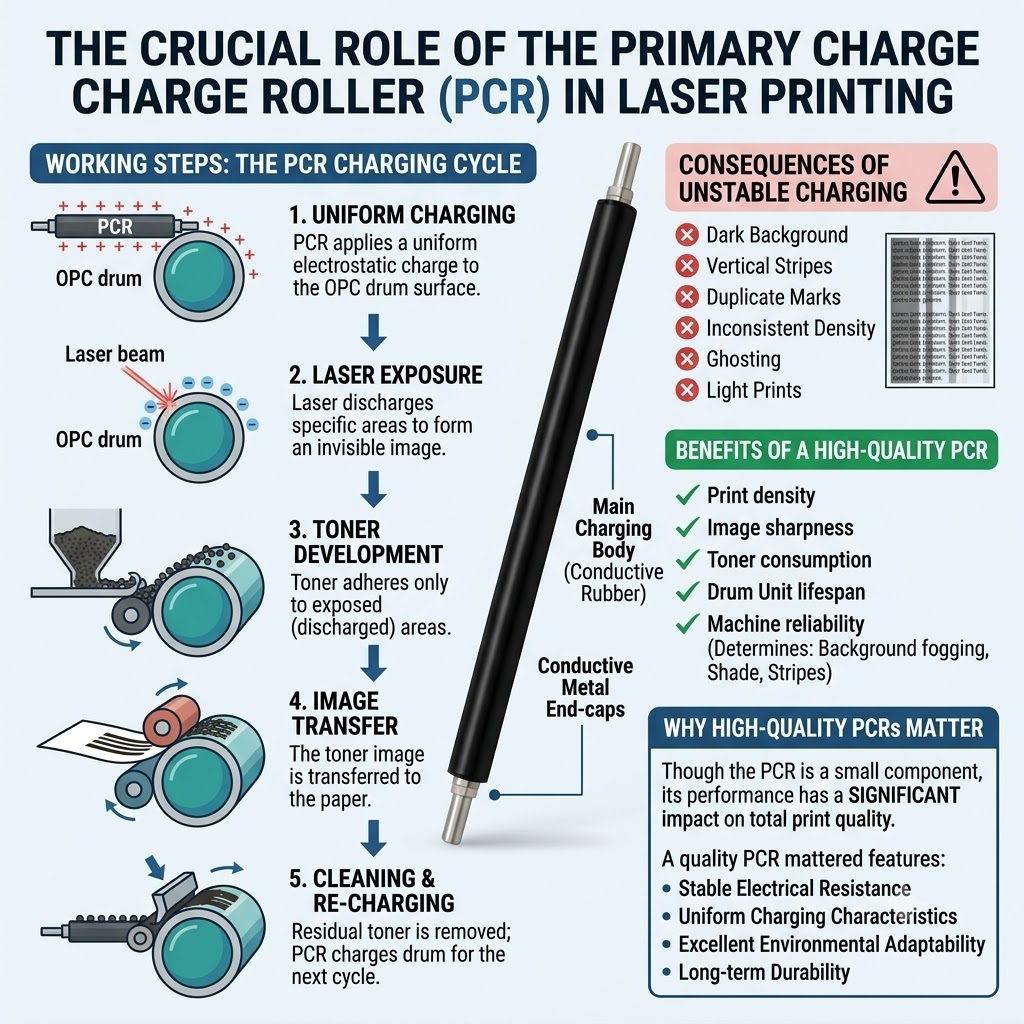
Many people mistakenly believe that toner powder determines print clarity, but this is not the case. Toner powder is responsible for color development, while the OPC Drum is responsible for image formation. The entire copying and printing process of a copier revolves around the OPC Drum, which is the foundation and core of all imaging stages. Four core functions are indispensable:
Optoelectronic Photosensitive Imaging: The OPC Drum possesses special photoelectric conversion characteristics, being insulating in the dark and conductive when exposed to light. During copier exposure, the original’s light and shadow are projected onto the OPC Drum surface, forming a precise electrostatic latent image that perfectly replicates the details of the original text and patterns. This is the first step in imaging and directly determines image clarity.
Toner Powder Adsorption and Development: The latent electrostatic image on the drum surface selectively attracts toner powder to corresponding areas, converting the invisible electrical signal into a tangible toner powder image. Imaging accuracy depends entirely on the uniformity of the OPC Drum coating and its photosensitivity.
Transfer and Fixing: Once the toner is attracted, the drum transfers the toner image onto the paper surface via electrostatic pressure, where it is cured in conjunction with the fixing assembly. The stability and surface flatness of the OPC Drum rotation directly determine whether ghosting, misalignment, or streaking occurs on the paper.
Cleaning and Reset Cycle: After each image is printed, the OPC Drum quickly removes residual charge and excess toner powder, returning to its initial state, ready for the next image. High-quality OPC Drum can achieve tens of thousands of stable cycles, while inferior OPC Drum are prone to residual toner powder and charge, leading to continuous printing failures.
In short: The quality of the OPC Drum directly determines print clarity, uniformity, and flawlessness, and also determines the overall lifespan of consumables and the
equipment failure rate.
III. Technical Challenges of the OPC Drum: Seemingly Simple, Yet Extremely High Core Barriers.
From the outside, the OPC Drum appears to be just a smooth, hollow aluminum roller. While its structure seems simple, it actually integrates multiple high-end technologies, including materials science, precision coating, optical processes, and precision machining. The main technical challenges are concentrated in four areas:
1. High-Precision Drum Base Material Process
The OPC Drum base material is a precision aluminum alloy tube, requiring extremely high standards for roundness, flatness, and wall thickness uniformity. Even slight eccentricity or unevenness in the base material will cause rotational vibration during equipment operation, directly leading to ghosting and inconsistent printing depth.
2. Precise Ratio and Spraying of Multi-Layer Photosensitive Coatings
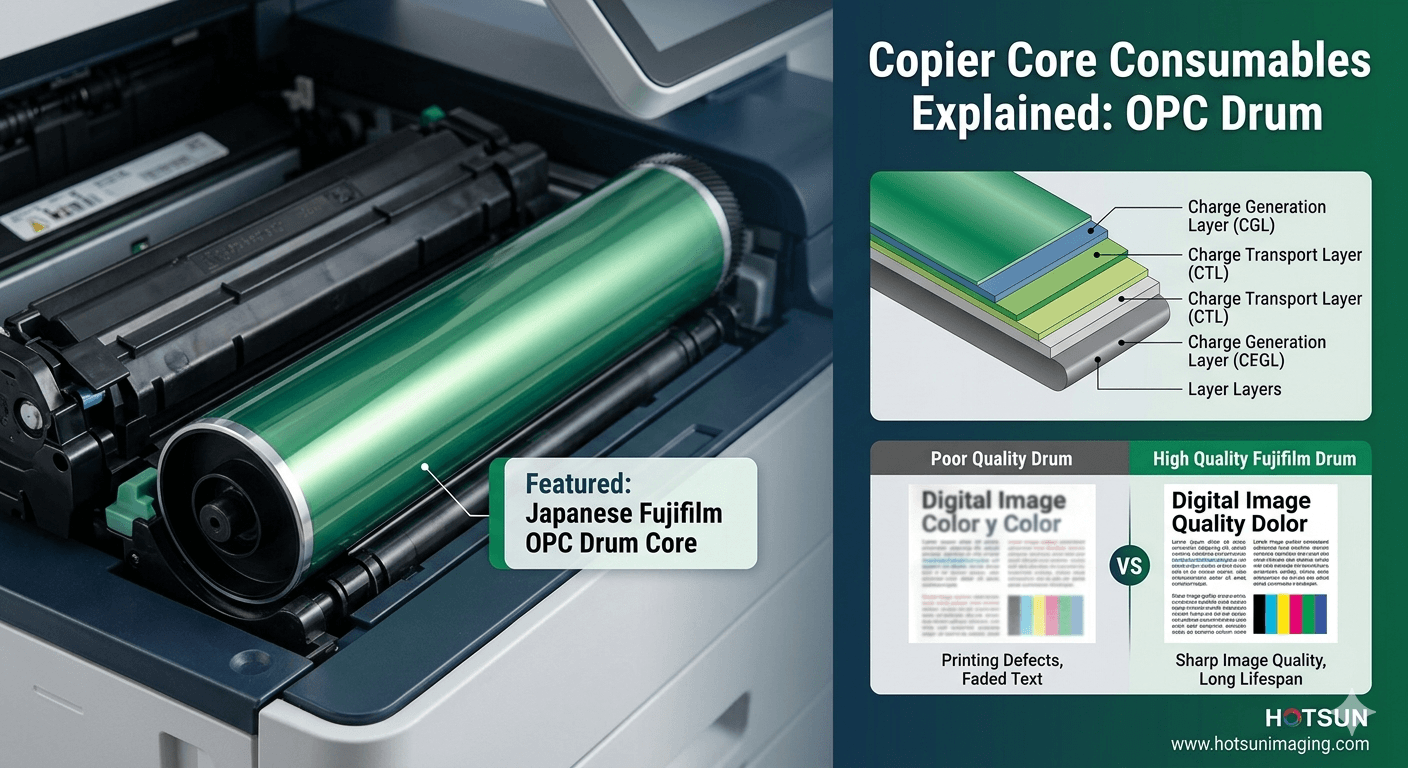
A high-quality OPC Drum is not a single-layer material, but rather composed of multiple layers of precision coatings, including a conductive base layer, Charge Generation Layer (CGL), Charge Transport Layer (CTL), and Overcoat Layer (OCL). The thickness, ratio, and adhesion of each coating layer adhere to strict standards. Coatings that are too thin are prone to wear and tear, while coatings that are too thick will affect photosensitivity. Imbalanced ratios will lead to image distortion and electrostatic instability.
3. Stable Control of Photoelectric Performance
High-quality OPC Drum must achieve uniform light sensitivity, precise charge release, and consistent response speed, unaffected by temperature, humidity, and voltage fluctuations. Low-end OPC Drum often suffer from localized light sensitivity failure and residual charge, leading to gray backgrounds, dirty pages, and partial color loss. Fujifilm OPC Drum undergo rigorous photoelectric calibration, ensuring uniform light sensitivity across the entire surface, making them suitable for various office environments, and maintaining stable operation even in high, low, and humid conditions.
4. Wear Resistance, Fatigue Resistance, and Long-Term Performance
Copiers are high-frequency, continuous-operation devices, and the OPC Drum must withstand tens of thousands of rotations, scraper friction, and electrostatic shocks. Inferior OPC Drum is prone to surface wear, oxidation, and aging, resulting in malfunctions after short-term use. High-end OPC Drum undergo special surface hardening treatment, significantly improving their resistance to friction, oxidation, and electrostatic breakdown, resulting in a lifespan far exceeding that of low-end OPC Drum.
IV. Quickly Distinguishing Between Good and Bad Drum Cores: Visual Inspection and Printing Effect Evaluation
Many users struggle to distinguish between high-quality and low-quality OPC Drum when purchasing consumables, leading to frequent printing malfunctions, short consumable lifespans, and equipment damage. Based on years of production experience, we have developed a dual standard for identifying high-quality OPC Drum: visual inspection and printing effect evaluation.
(I).Visual Inspection
Surface Gloss: High-quality Fuji OPC Drum have a smooth, delicate surface with uniform and clear gloss, free of impurities and haze, and a consistent overall color. Inferior OPC Drum have a dull, hazy surface with uneven gloss in some areas, fine particles, and color differences; they are often recycled, refurbished, or produced using low-end coating processes.
Surface Smoothness: High-end OPC Drum are smooth and even throughout, without scratches, pinholes, bubbles, or bumps. Inferior OPC Drum often have fine pinholes, coating particles, and edge wear.
Craftsmanship Details at Both Ends: High-quality OPC Drum have regular, burr-free, and highly concentric shafts at both ends, with no deviation during rotation. Inferior OPC Drum have rough workmanship at both ends, with burrs and significant shaft deviation.
Abrasion and Scratch Resistance: Fuji’s high-end OPC Drum have a highly abrasion-resistant surface; slight wiping and friction will not leave marks. Inferior OPC Drum have a soft coating; even light wiping will cause scratches and powdering, leading to damage and failure after short-term use.
(II).Printing Quality Identification (The Most Accurate Core Standard)
1.High-Quality OPC Drum Printing Performance
: Clean pages with no background color or gray undertones; clear and sharp text lines with no burrs at the edges; even and full color filling; continuous printing without ghosting, streaks, or color differences; tens of thousands of pages printed continuously with consistently stable image quality, without degradation or malfunctions.
2. Typical Fault Symptoms of Inferior OPC Drum
Severe Graying: The entire page appears grayish, with small black dots scattered throughout blank areas;
Periodic Stripes/Black Lines: Horizontal and vertical lines appear at fixed intervals on the page, corresponding to localized wear and coating damage on the OPC Drum;
Faded and Uneven Text: Localized text is blurry or faded, with noticeable color differences across the page;
Ghosting/Afterimages: Overlapping content between pages, leaving afterimages, caused by charge reset failure;
Extremely Short Lifespan: Large-scale failures occur after only a few thousand pages, requiring frequent replacement of consumables and increasing maintenance costs.
(III). Identification with Professional Equipment (Most Professional)
1. Coating Thickness Meter (Non-destructive Testing, Identifying Refurbished/ Low-End Coatings)
This meter uses non-destructive optical testing technology to accurately measure the thickness of the multi-layer photosensitive coating on the OPC Drum. The thickness of a typical original OPC Drum is 40µm±3mm. Fujifilm’s OPC Drum thickness is 36µm±2mm.
2. Wear and Fatigue Life Test (Simulated Long-Term Operating Conditions) Simulating the high-frequency continuous operation of a copier
, the OPC Drum undergoes tens of thousands of continuous rotations, scraper friction, and electrostatic shock tests to quickly verify its wear resistance, anti-aging properties, and fatigue resistance, predicting long-term failure rates.
During testing, the OPC Drum thickness is tested every 5000 pages printed until the end of its printing lifespan. OPC Drum thickness is also randomly checked in each batch of goods.
3. High-Precision Image Grayscale Analyzer (Quantifying Print Quality)
Unlike manual visual judgment of print quality, this device can quantitatively analyze the grayscale value, uniformity, number of blemishes, stripe depth, and color difference of printed samples, achieving data-driven and standardized print quality.
For example, a qualified drum unit will clearly display the hair on the neck of a zebra when printing a black and white image, while a substandard drum unit will only print a completely black image.
4. High and Low Temperature Humidity Test Chamber (Environmental Adaptability Testing)
Simulates complex office environments such as high temperature, low temperature, humidity, and dryness to test the performance stability of the OPC Drum under extreme environments and identify inferior OPC Drum with poor environmental adaptability.
In conclusion
The OPC Drum, as the core of a copier’s imaging system, is a decisive factor in the quality of consumables. Low-priced, inferior OPC Drum lead to frequent malfunctions, inefficient operations, and equipment wear and tear, while high-quality Fujifilm OPC Drum deliver long-term stability, high-definition performance, high efficiency, and lower overall maintenance costs.
In the future, we will continue to focus on the high-quality copier consumables field, using top-tier core materials, stringent manufacturing processes, and professional quality control standards to provide global customers with highly stable and cost-effective copier parts and consumable solutions, ensuring stable and efficient operation of every machine!
Hotsun Imaging|Professional Copier Consumables Manufacturer