A Professional Manufacturer’s Guide to Understanding Product Quality
With more than 20 years of experience in the copier imaging industry, we have learned that the quality of a compatible copier drum unit is determined long before the finished product reaches the customer.
A high-quality compatible drum unit should not simply be a lower-priced alternative to an OEM unit. It should provide **stable print quality, reliable page yield, good toner compatibility, and consistent performance**, while offering a significantly better cost-to-performance ratio.
So, how can you tell whether a compatible drum unit is truly high quality?
Instead of simply telling you that our products are reliable, I would like to take you behind the scenes and explain how we develop, test, manufacture, and inspect our products.
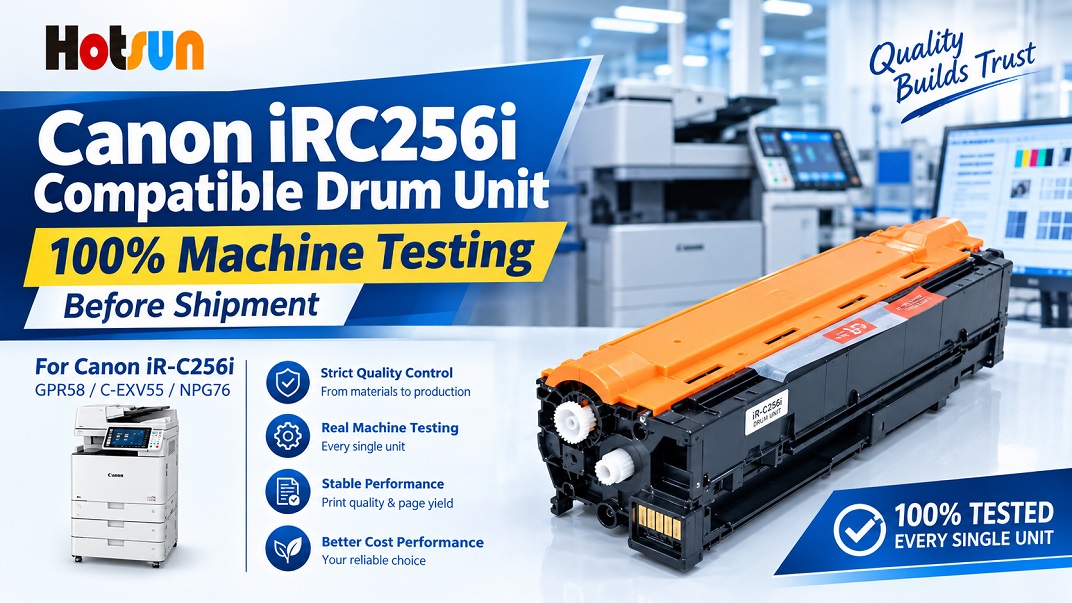
I will use the **Canon imageRUNNER ADVANCE C256i (iR-C256i),OEM Number :2186C003AA,GPR58,C-EXV55,NPG76** compatible drum unit as an example.
From initial development and component selection to trial production, mass production, printing inspection, cleaning, sealing, and final packaging, every stage plays an important role in determining the quality of the finished product.
We will also publish videos showing different stages of our production process on our website and social media channels, allowing customers and copier technicians to see how compatible drum units are actually made.
1. Product Development & Testing
Product development is the foundation of quality.
Before a new compatible drum unit enters production, our development team evaluates components from different suppliers and builds multiple configurations for real-world testing.
For the Canon iR-C256i(GPR58,C-EXV55,NPG76), we continue testing until the performance and page yield reach our target benchmark. The OEM drum unit is rated at approximately **45,000 pages**, and this provides an important reference point during our development process.
During testing, we record detailed printing data and retain print samples at regular intervals. Every /5,000 pages**, we evaluate key performance indicators, including:
* Drum core condition and wear
* Toner consumption
* Print density
* Blackness
* Color consistency
* Contrast
* Overall print quality
### Toner Compatibility Testing
A drum unit does not work independently. Its performance is closely related to the toner used in the machine.
Therefore, we test our drum units with different compatible toners as well as OEM toner. Particular attention is given to toners from major Japanese manufacturers, including **Mitsubishi, Tomoegawa, Sakata, and Mikasa**, to evaluate compatibility under different conditions.
### Temperature & Humidity Testing
We also conduct tests under different temperature and humidity conditions.
This helps us identify whether individual components remain stable when environmental conditions change.
Only after completing repeated testing do we finalize the component combination and production configuration.
Once the optimal configuration has been established, we keep the specifications consistent throughout production. This helps ensure that different production batches maintain stable and predictable performance.
In other words, quality is not something we check only at the end of production. It is designed into the product from the beginning.
We are also preparing a dedicated video showing our product development and testing process, which will be published on our company website.
2. Small-Batch Trial Production
After development and testing are completed, we move to small-batch trial production.
For a new model, we normally produce approximately **100–200 units** for initial evaluation.
These units are supplied to long-term customers in different markets so that we can collect feedback from actual machines and real-world applications.
We carefully monitor feedback regarding:
* Print quality
* Page yield
* Toner compatibility
* Installation
* Machine operation
* Transportation and storage
* Long-term stability
We only move to full-scale production after the product has demonstrated sufficient stability.
This additional stage helps us identify problems that may not appear during laboratory testing alone.
3. Mass Production: Where Quality Is Built Into Every Unit
After development and trial production are completed, the product enters mass production.
This is the stage where manufacturing discipline becomes especially important.
A compatible drum unit may look simple from the outside, but producing a stable, high-quality unit requires numerous manual processes and strict quality controls.
Below is an overview of our production process.
3.1 Disassembly of Reclaimed Cartridges
We begin with carefully selected reclaimed original cartridges.
The cartridges are first cleaned and dusted before being completely disassembled into individual components.
Depending on the product, we selectively reuse suitable components such as:
* Original plastic housings
* Magnetic rollers
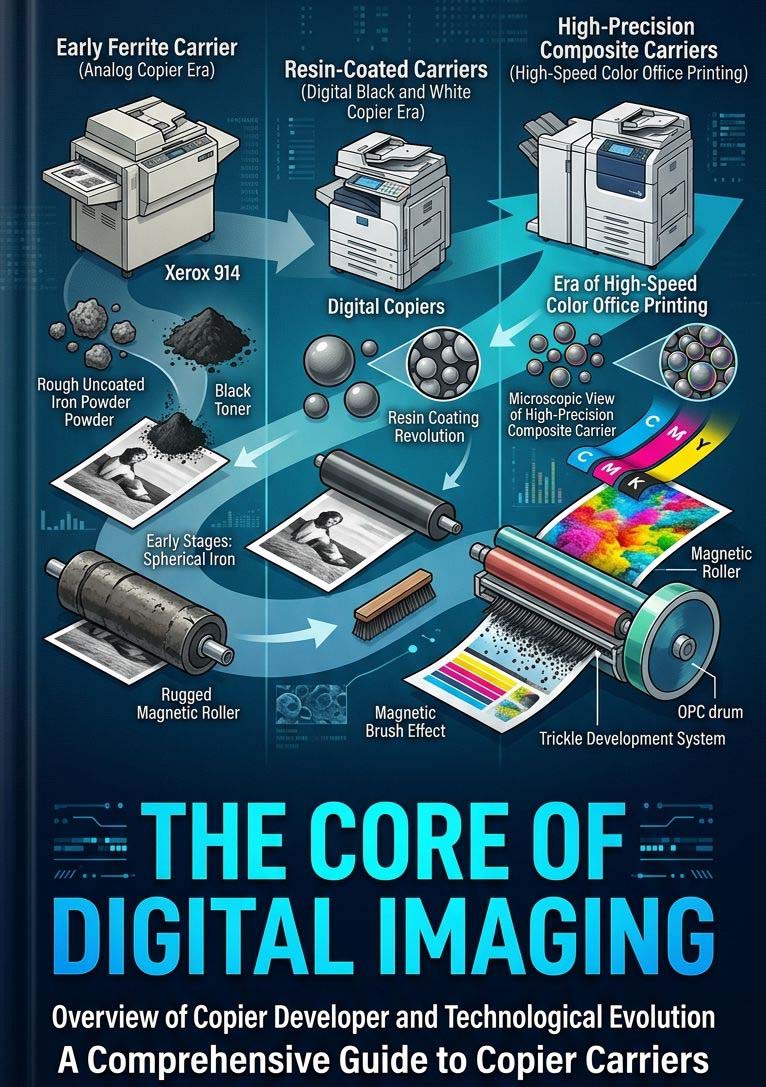
* Processed developer/carrier
Other critical wear components are replaced with new parts.
### Why Reuse Original Plastic Housings?
One important reason is **resource conservation and environmental responsibility**.
Reusing suitable original plastic components reduces unnecessary material consumption and gives existing components a second life.
From a technical perspective, original plastic housings can also offer excellent dimensional accuracy and material consistency.
However, we do not reuse components simply because they are original. Each component must meet our quality requirements before it is allowed back into production.
3.2 Thorough Cleaning of the Plastic Housing
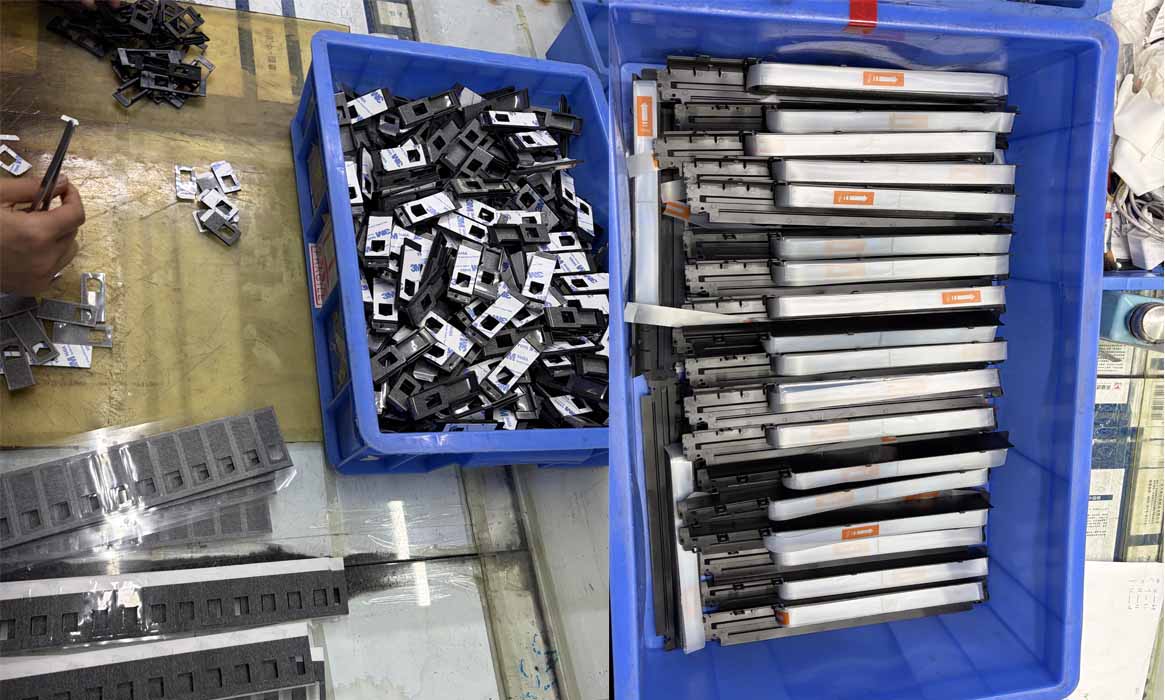
After disassembly, all old felt, foam, adhesive residue, and labels are removed from the plastic housing.
This is a slow and detailed process.
The housing must be cleaned thoroughly so that old adhesive and other contaminants do not remain inside the unit.
Although this step may look simple, it is one of the most time-consuming parts of the remanufacturing process.
A clean foundation is essential for the next stages of assembly.
3.3 Replacing Foam, Felt & Double-Sided Tape
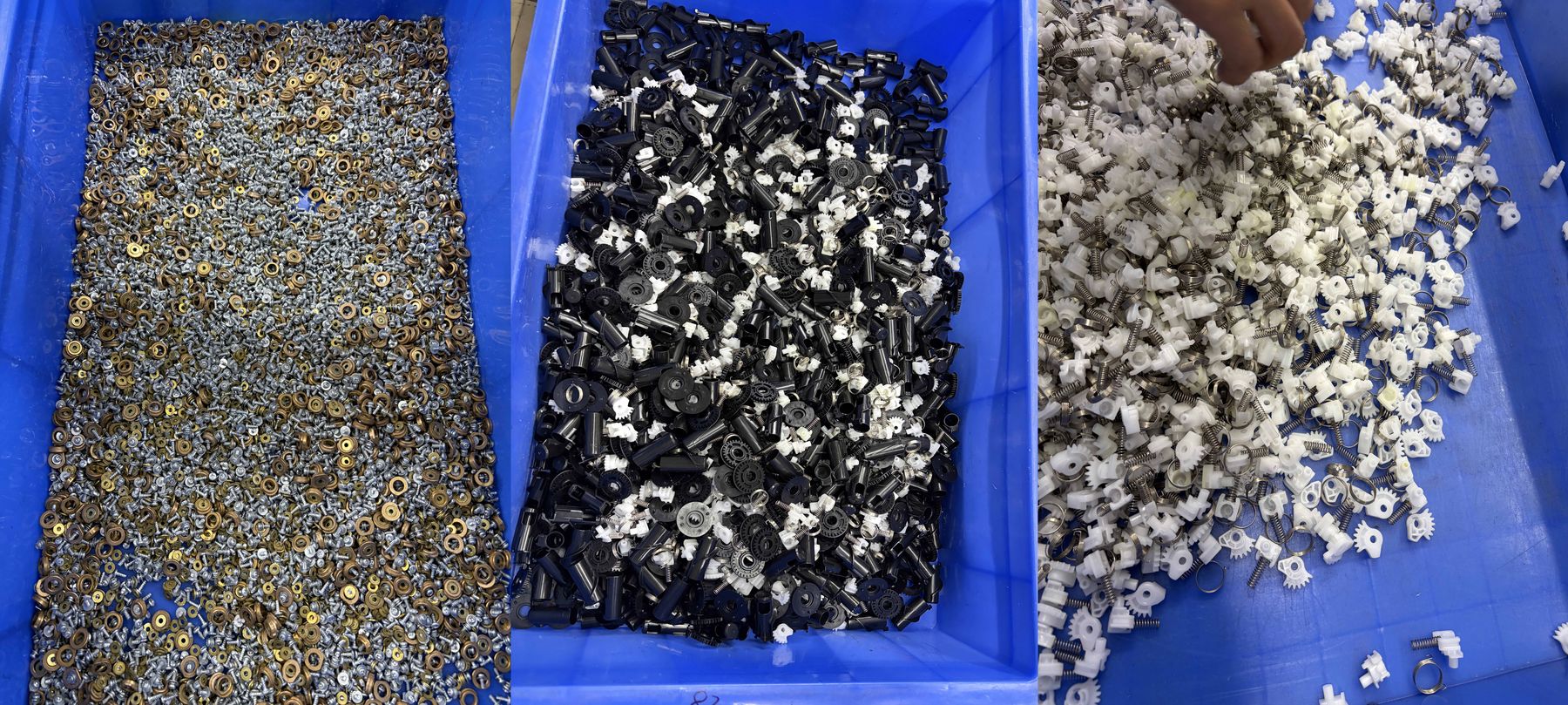
After cleaning, new foam, felt, and double-sided tape are installed.
We use **3M double-sided tape and selected felt materials** to improve stability and service life.
### Why Replace Felt and Foam That Still Look Good?
This is an important question.
Felt, foam, and adhesive materials can age over time, even when they still look acceptable.
As these materials age:
* Foam can harden or crumble
* Felt can deteriorate
* Adhesive can lose its bonding strength
* Small fragments can enter the developer or toner path
* Sealing performance can deteriorate
These problems may eventually contribute to issues such as toner leakage, contamination, or abnormal print quality.
Because the original age and service history of reclaimed components cannot always be determined, simply checking their appearance is not enough.
For this reason, we replace these materials rather than relying on their original condition.
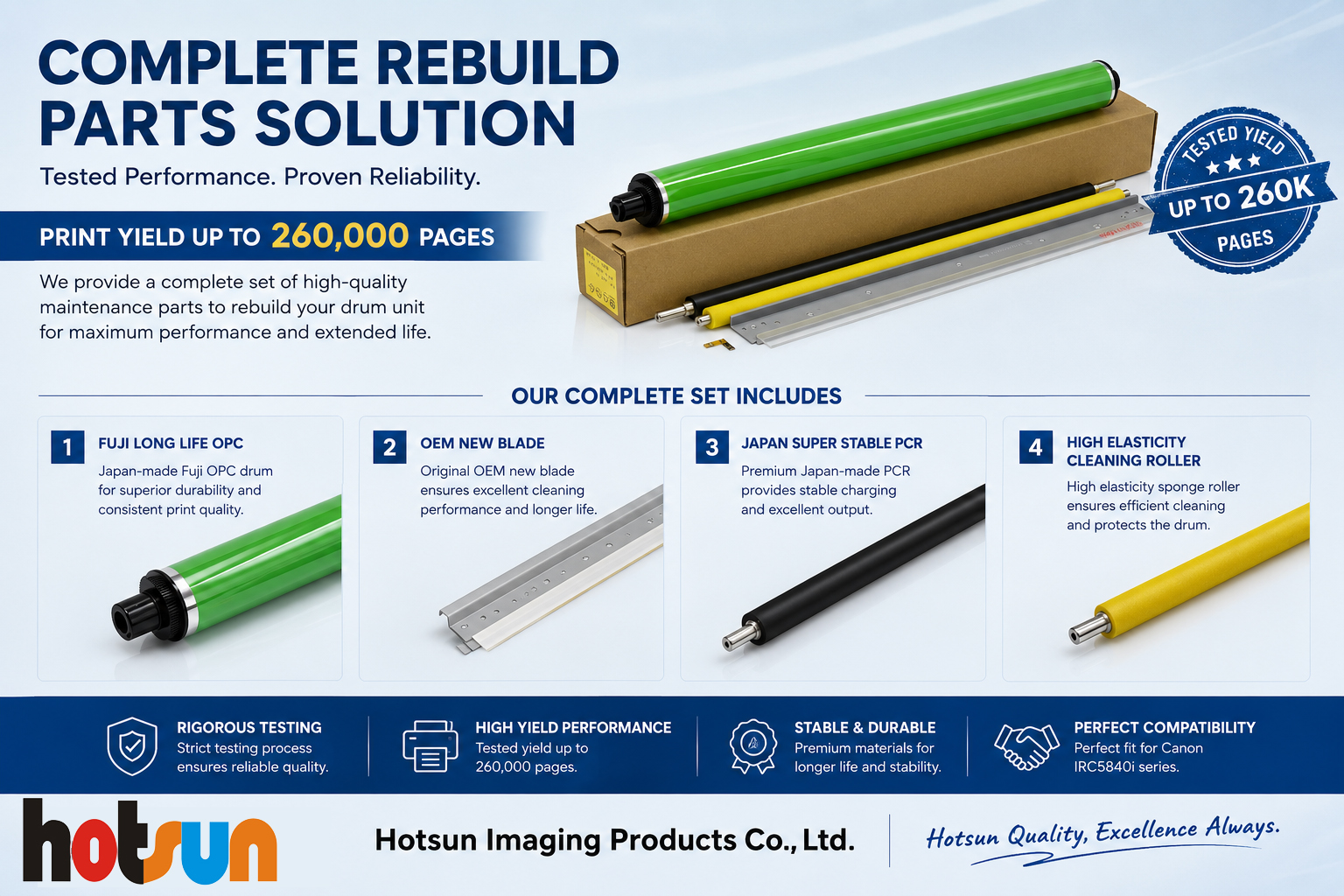
3.4 Installing New Critical Imaging Components
Next, we assemble the key imaging components, including the:
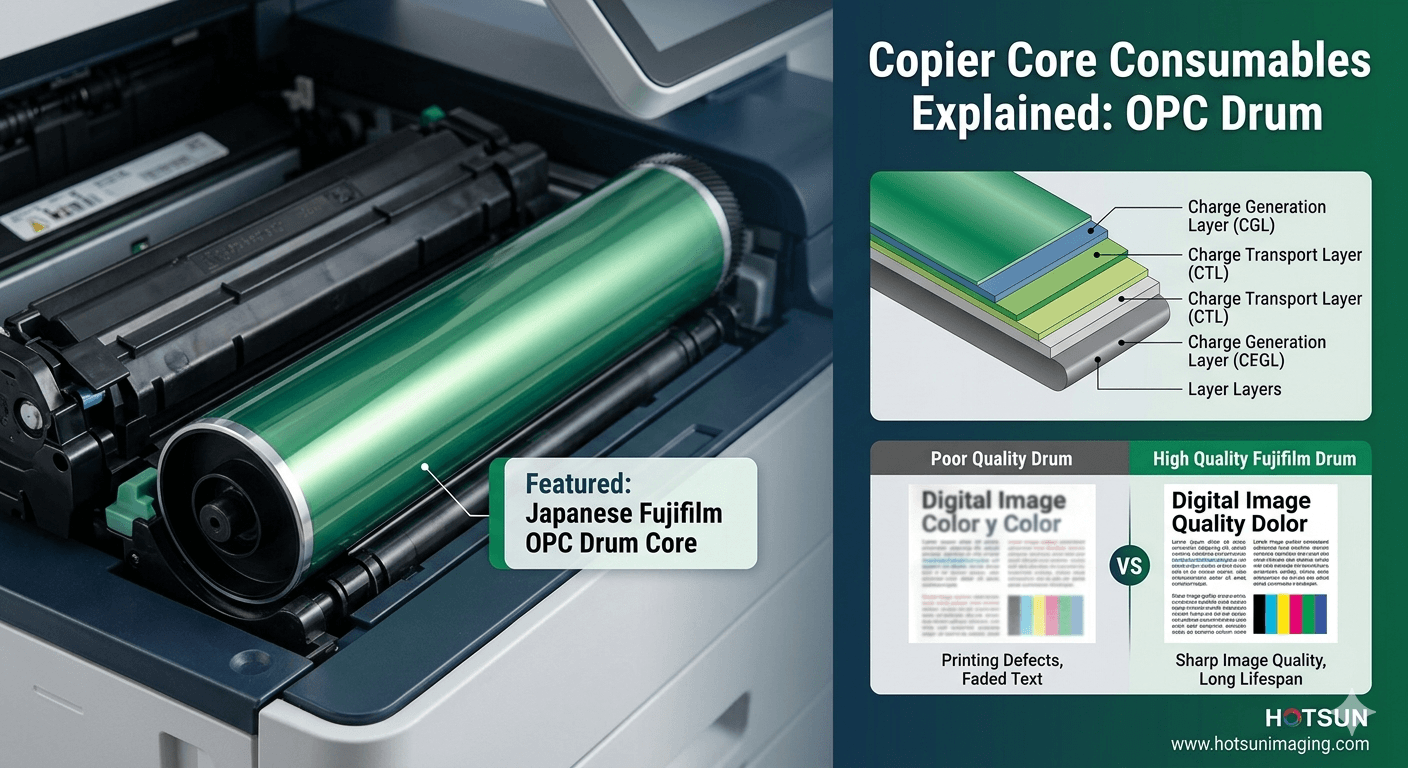
* Drum core
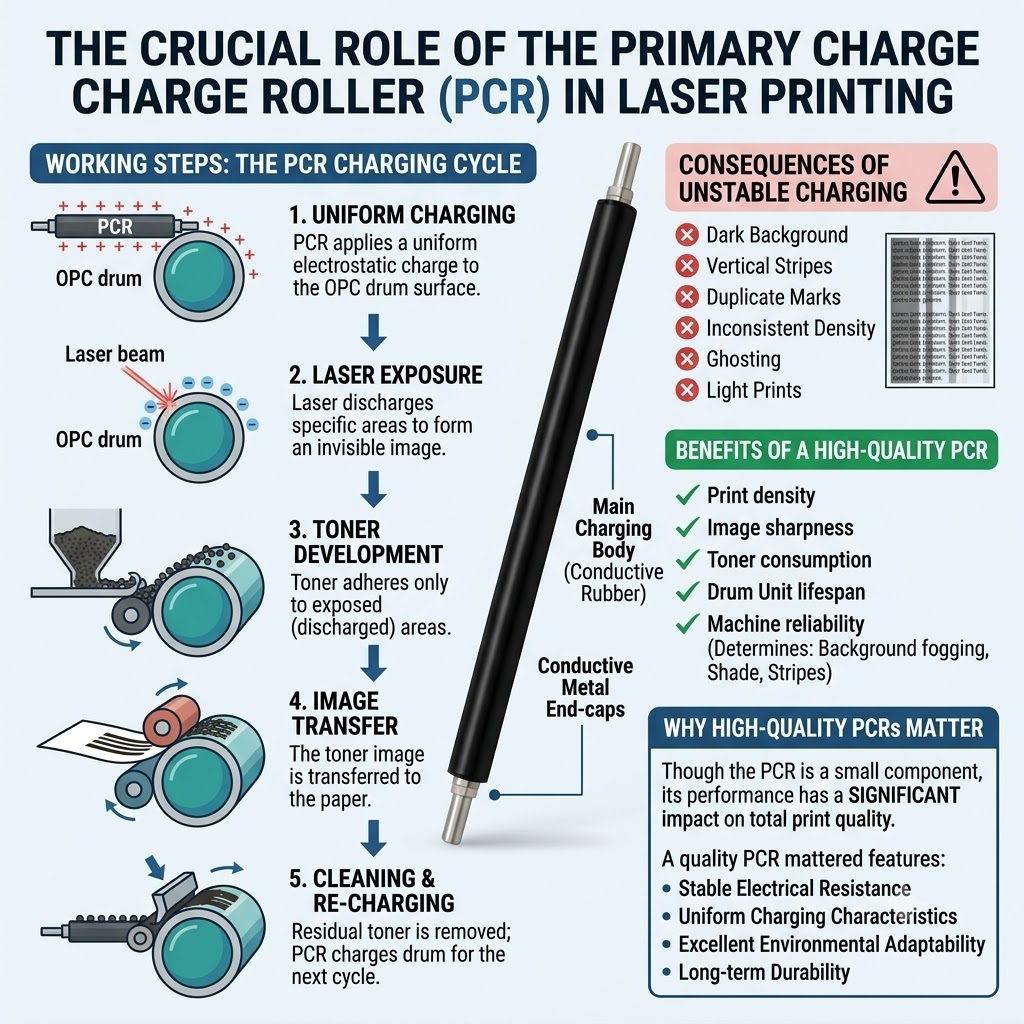
* Primary charging roller (PCR)
* Cleaning blade
* Magnetic roller
* Other required components
### Why Replace the Drum Core, PCR and Cleaning Blade?
These components directly affect print quality and service life.
Over time:
* The drum core wears and its performance becomes less predictable
* The rubber material of the charging roller can deteriorate
* The electrical characteristics of the charging roller can change
* The cleaning blade can age and lose its proper working characteristics
* Adhesive materials can deteriorate with time
Even a relatively small defect in one of these components can result in problems such as poor density, backgrounding, streaks, toner leakage, or unstable printing.
Therefore, for critical wear components, we use new components rather than relying on the condition of old parts.
This is one of the major differences between a carefully remanufactured drum unit and a simple recycled or rebuilt product.
3.5 Developer Installation & 100% Print Testing
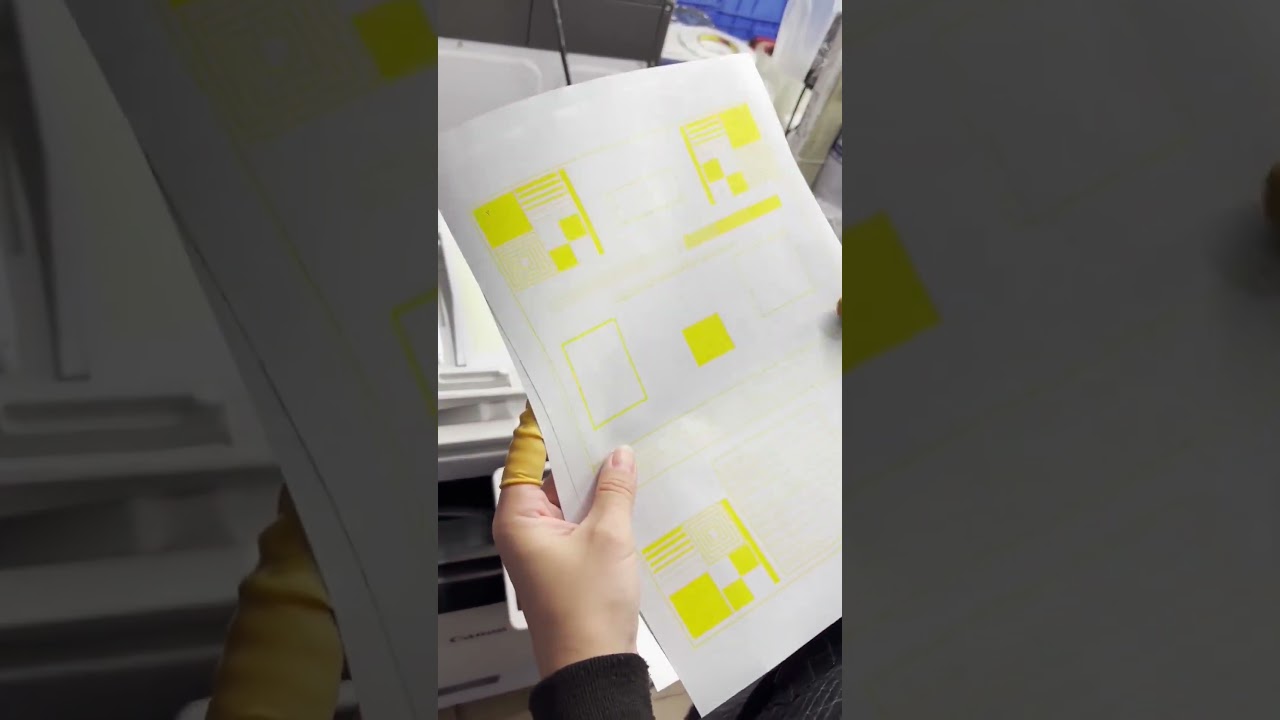
After assembly, the developer/carrier is installed and the unit is loaded into the copier for actual printing.
**Every finished unit undergoes a real-machine printing inspection.**
### Why Test Every Unit If the Product Has Already Been Tested During Development?
Because product development and mass production are two different stages.
During development, we verify the design and component configuration.
During mass production, we must verify the **actual assembly quality of every individual unit**.
Most of our assembly processes are performed manually. Even with trained and experienced technicians, the possibility of an occasional assembly error cannot be completely eliminated.
That is why we do not rely only on sampling inspection.
**Every unit must pass actual printing inspection before moving to the next stage.**
### Why Is Developer/Carrier Required in a Copier Drum Unit?
This is another important difference between many copier systems and standard desktop printers.
In many copier imaging systems, the developer/carrier plays an important role in controlling the toner concentration and transferring toner to the imaging system.
The machine monitors the toner-to-developer relationship and adjusts the system accordingly.
Therefore, the developer/carrier condition and quantity are important for maintaining stable print density and overall image quality.
3.6 Abnormal Print? Return to the Production Line
If a unit produces abnormal printing during inspection, it does not simply get passed or shipped.
The unit is returned to the production line for investigation.
Our engineers analyze the printed output and identify the possible cause.
If the problem is related to an assembly error, the responsible operator receives additional training and the relevant process is reviewed.
If the issue is related to a component or production condition, it is reported to the workshop supervisor for further process control.
After repair and adjustment, the unit must go through the printing inspection again.
**The unit only proceeds when the printing result meets our requirements.**
3.7 Final Cleaning, Sealing & Carrier Reassembly
After the printing inspection is completed, the unit enters the final preparation stage.
The unit is carefully disassembled as required so that residual developer and toner can be thoroughly cleaned.
The developer chamber is then sealed before the developer is reloaded.
### Why Is Sealing So Important?
The sealing process must be performed carefully and in a clean environment.
Poor sealing or contamination on the bonding surface can reduce adhesion and potentially result in developer or toner leakage during transportation or storage.
We therefore pay particular attention to the cleanliness of the sealing area before applying the sealing tape.
The waste toner area is also cleaned thoroughly.
### Why Does the Waste Toner Bin Contain Residual Toner?
During normal printing, a small amount of toner is inevitably collected in the waste toner area.
Even a small amount of residual toner can become loose during transportation, especially when the package is exposed to vibration or impact.
Therefore, final cleaning is necessary before the product is sealed and packed.
4. Labeling, Protective Packaging & Storage
After final assembly and inspection, the product is prepared for shipment.
The final process includes:
**Labeling → Sealed Bag → Protective Foam → Carton → Warehouse Storage**
Each unit is placed in a sealed bag to help maintain a clean and dry storage environment.
We also use specially designed **shock-absorbing and pressure-resistant foam inserts** to protect the drum unit during transportation.
The packaging is designed to reduce the risk of damage caused by:
* Impact
* Vibration
* Compression
* Long-distance transportation
* Rough handling
For different products, we develop suitable protective packaging according to the structure and transportation requirements of the unit.
What Really Defines a High-Quality Compatible Drum Unit?
From our perspective, a high-quality compatible copier drum unit is not simply a product that looks similar to an OEM unit.
It should be the result of:
**Good Component Selection**
↓
**Professional Product Development**
↓
**Real-World Testing**
↓
**Small-Batch Validation**
↓
**Controlled Mass Production**
↓
**100% Print Inspection**
↓
**Final Cleaning & Sealing**
↓
**Protective Packaging**
Every step contributes to the final result.
The goal is simple:
**Stable Print Quality + Reliable Page Yield + Good Toner Compatibility + Consistent Performance + Better Cost Efficiency**
## Our Approach to Compatible Copier Drum Units
At Hotsun, we believe customers should have more information when choosing compatible imaging products.
Rather than simply asking customers to trust a manufacturer’s claims, we want to show **how the product is developed, tested, manufactured, inspected, and packaged**.
With more than 20 years of experience in the copier imaging industry, we continue to improve our processes and test different components and configurations to provide reliable solutions for distributors, wholesalers, leasing companies, copier technicians, and other professional partners around the world.
We will continue sharing our production processes, testing methods, technical knowledge, and product development experience through our website and social media channels.
If you are evaluating a compatible copier drum unit, don’t only compare the price. Ask about the components, testing, page yield, toner compatibility, production process, and quality control behind the product.